
Kia PV7 or a Carnival? What to check before waiting for the electric family van
Kia's new electric van makes a tempting family-car candidate. Before waiting, separate launch plans from order availability, measure your parking space, and read the range and charging qualifications.
A big box on wheels can look like a delivery vehicle. Give it generous windows and a flat cabin, and the same box starts to look like the next family car. That is the appeal of the Kia PV7 revealed on September 14. If a Carnival was already on your shortlist, waiting for an electric alternative is an understandable thought.
But the calendar matters first. Kia plans an initial launch in Korea and Europe in the second half of 2027; that is not an on-sale date for every country. The announcement reviewed on September 15 does not provide a Korean retail price. A household needing a car now has a different decision from one that can wait. For either, the generous space inside also occupies generous space outside.
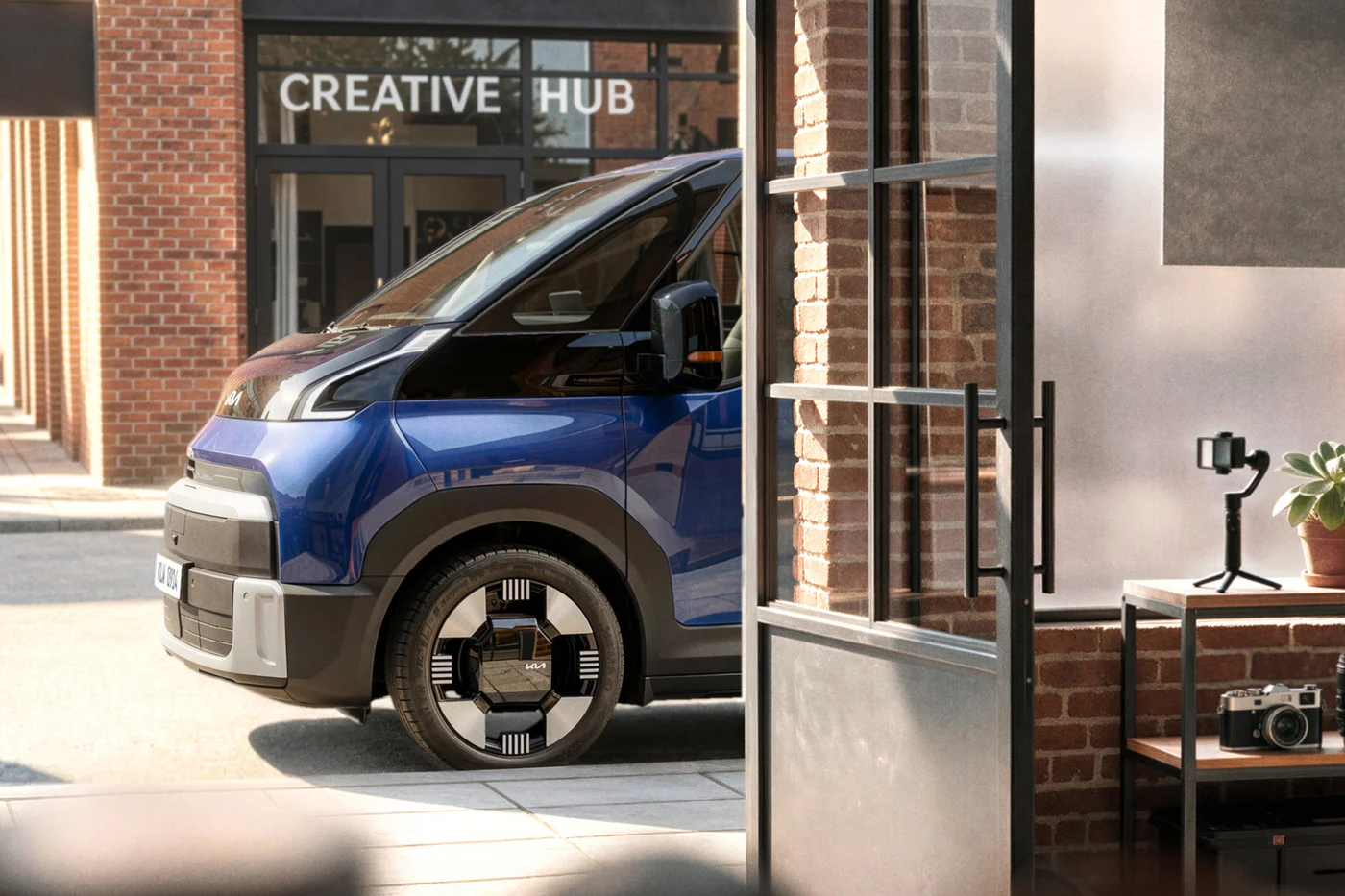
Before imagining a lounge, measure the space outside it
The announced Long body measures 5,350mm in length and 1,990mm in height. The quoted 1,995mm width excludes mirrors and door handles. Those qualifications matter more beside a garage pillar than in a brochure: a painted bay does not describe the entire path from the street to your parking position.
Suppose you measure five metres of usable parking length. The vehicle body is 35cm longer. Splitting that difference between the front and rear does not create clearance; the space is still too short. Five metres here is a worked example, not a claim about any country's statutory parking dimensions.
Likewise, a two-metre entrance minus a 1.99-metre body leaves only one centimetre on paper. That is not a clearance certification. Ramp transitions, overhead fixtures and the actual vehicle specification still matter. Before collecting camping accessories, collect photographs and measurements of the place where the van will spend most nights.
A seat count cannot tell you whether the family fits
Kia describes seven-, nine- and eleven-seat Passenger versions, but the individual features belong to particular derivatives. The sliding and removable seven-seat arrangement in the announcement is specified for the Compact model; the initial Korean launch concerns Long versions. Combining every attractive feature into one imaginary launch model would be a costly misunderstanding.
For a family, the useful question is what luggage space remains on the day every seat is occupied. A household carrying four people on weekdays and grandparents on holidays needs a place for a stroller and bags after the passengers sit down. A promotional view of an empty floor cannot answer that question by itself.
There is therefore no responsible Carnival-versus-PV7 winner yet. The PV7 presents an electric-van proposition with useful space; family satisfaction also depends on ride quality, rear-seat comfort and usable luggage room. An announcement can establish the proposition without substituting for a test drive. Adding a candidate to a shortlist is a much smaller commitment than selling the car you already own.
Whose range figure are you reading?
The headline figure belongs to a Cargo Long Range configuration: more than 460km on Kia's internal WLTP-based measurement. It is not a certified local range result for every Passenger model. Repeating it as a family version's guaranteed driving distance changes both the vehicle and the test claim.
A weekend journey also continues after arrival. You may drive between accommodation, restaurants and activities, then leave again the next morning. A household able to charge at its destination has a different experience from one that must make a separate trip to a public charger.
Choose one long journey you actually repeat. Note the departure charge, whether you can charge at the destination and one sensible intermediate alternative. When the relevant local Passenger specification arrives, evaluate it against that journey. That produces a more useful answer than borrowing another driver's definition of enough range.
Two charging ports solve a parking question, too
Kia describes front AC/DC access plus a rear-side AC port. That does not mean plugging in twice to double charging speed. The practical attraction is flexibility around where a cable can reach: positioning a long vehicle is part of the charging experience.
The announced rapid-charging time, in the mid-twenties of minutes, covers 10 to 80 percent under Kia's measurement conditions. It is not an empty-to-full promise. A casual claim that charging takes one coffee break can omit the queue, the available charger and whether the car and charging equipment meet the necessary conditions.
Conversely, a household that can charge during long stops at home or work may rarely need the highest possible charging output. Convenience can come from many days without a separate charging errand, rather than one exceptionally fast stop. Keep the launch-stage performance claim and that everyday benefit separate.
Prepare a comparison, not a guessed price
There is no need to fill the missing retail price with an estimate. Prepare the comparison instead: the seats your household will use, the equipment you consider necessary and the charging arrangement you can actually access. Those conditions will make the eventual quote more meaningful.
A household with substantial daily mileage, charging at home and generous parking could find the size and electric drivetrain complementary advantages. For predominantly short urban trips with difficult parking, the bigger cabin may instead create inconvenience outside the car every day. Size is both the attraction and the reason this will not suit everyone.
The decision today is whether waiting belongs on your shortlist. Check that your replacement schedule allows it and that parking and charging make sense. Then return when your market has a price, a specific Passenger configuration and an applicable certified range figure. Korea and Europe being named in a launch plan does not establish a North American arrival or universal regional availability.
Sources and verification notes
- Kia — September 14 Korean launch announcement and specification footnotes ↗Checked 2026-09-15
What this source supports
- Before imagining a lounge, measure the space outside it
- A seat count cannot tell you whether the family fits
- Whose range figure are you reading?
- Two charging ports solve a parking question, too
- Prepare a comparison, not a guessed price
- Kia — PV7 world premiere: space and use cases ↗Checked 2026-09-15
What this source supports
- A seat count cannot tell you whether the family fits
- Kia Corporation — global PV7 announcement ↗Checked 2026-09-15
What this source supports
- Whose range figure are you reading?
- Two charging ports solve a parking question, too
- Prepare a comparison, not a guessed price
- AAGAG — community topic discovery, not product verification ↗Checked 2026-09-15
- Kia Sweden — original teaser image and media-use licence ↗Checked 2026-09-15
- Kia Sweden — official teaser film link ↗Checked 2026-09-15