
NVIDIA revenue hit $96.2 billion. Why read cash flow separately?
Separate NVIDIA’s operating performance from its valuation: data-center revenue, cash collection and infrastructure commitments answer different investment questions.
Strong earnings do not make the buy button easy to press. Recent investor discussions ask both why NVIDIA is not rewarded more and whether too much future growth is already priced in.
Revenue records sales; operating cash flow records cash moving through operations during the period. Reading NVIDIA’s results requires both. Customer payment terms and infrastructure commitments reveal business demands that a growth percentage alone cannot show.
Start with what NVIDIA sells
NVIDIA supplies accelerated computing, networking and a supporting software ecosystem. Its opportunity depends on customers building and operating infrastructure, not simply on one chatbot being popular. Continued spending across customers is therefore more informative than a single application launch.
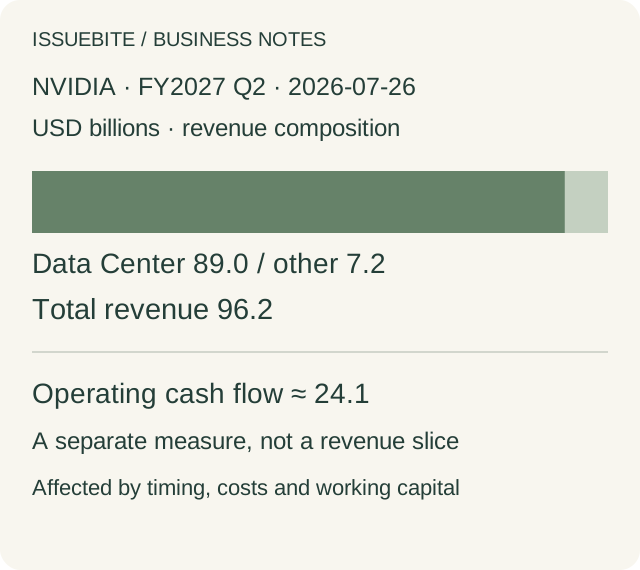
For fiscal Q2 2027, ended July 26, 2026, reported revenue was $96.2 billion, including $89.0 billion from Data Center. The latter is about 93% of the total. That calculation shows the business mix; it does not turn the whole segment into revenue from a particular generative-AI model.
A sale and a cash receipt are different events
Quarterly operating cash flow was $24.077 billion. Subtracting $2.677 billion of purchases related to property, equipment and intangible assets gives $21.4 billion. This is a calculation using those named lines, not cash remaining after every investment or a promise for future quarters.
The 10-Q describes extended payment terms of 90 days to one year for some investment-grade customers making large builds. That does not establish bad sales. It does make revenue, receivables and cash flow worth reading together: stronger sales can require more financing before the cash arrives.
Gigawatts are not a revenue forecast
The September 9 Australian announcement describes a buildout of up to 2GW by 2027. Capacity is not a GPU order value or revenue already recognized. Sites, power, funding and actual customer deployment still have to connect.
The filing also describes commitments and guarantees supporting some customers’ infrastructure. These may enable sales while adding counterparty and execution exposure. Their existence does not prove fictitious demand; it means investors should examine financing obligations alongside equipment demand.
Put a price on an assumption, not a slogan
Consider a fictional stock at $100. An expected annual EPS of $5 means paying 20 times those expected earnings. Reduce the estimate to $4 and the same price becomes 25 times. These are teaching numbers, not NVIDIA’s price, forecast or recommended multiple.
Use a current quote and an earnings estimate covering a clearly identified year, then challenge the estimate against customer spending, cash collection and commitments. This article has not established a current market quote and consistent forward earnings estimate, so it does not label NVIDIA cheap today.
Sources and verification notes
- NVIDIA FY2027 Q2 results — August 26, 2026 ↗Checked 2026-09-15
What this source supports
- Start with what NVIDIA sells
- A sale and a cash receipt are different events
- Put a price on an assumption, not a slogan
- NVIDIA FY2027 Q2 Form 10-Q — cash flows, Note 7 and commitments ↗Checked 2026-09-15
What this source supports
- Start with what NVIDIA sells
- A sale and a cash receipt are different events
- Gigawatts are not a revenue forecast
- Put a price on an assumption, not a slogan
- NVIDIA Australia infrastructure announcement — September 9, 2026 ↗Checked 2026-09-15
What this source supports
- Gigawatts are not a revenue forecast
- Reader question: Is Nvidia good value right now? ↗Checked 2026-09-15
What this source supports
- Put a price on an assumption, not a slogan
- Reader question: Is the valuation still justified? ↗Checked 2026-09-15
What this source supports
- Put a price on an assumption, not a slogan